
New York City has recently taken a significant step to address its housing crisis by enacting major zoning reforms. The key provisions of the recently adopted initiative aim to make it easier for homeowners to create legal Accessory Dwelling Units (ADUs). Once the final rules are officially adopted by the Department of Buildings (DOB) later this year, some homeowners will have various options for adding ADUs, such as converting basements and attics, making additions to their existing homes, or constructing new detached structures in their backyards.
These changes are part of the “City of Yes for Housing Opportunity” initiative, marking an important moment for housing policy. However, a closer look reveals that considerable regulatory challenges will still exist. An analysis by the Regional Plan Association (RPA) indicates that only 12% of the city’s one- and two-family properties will be allowed to have an ADU. Additionally, the implementation of these rules and the accompanying supportive programs has been fraught with confusion. The limited scope and uncertainty are likely to restrict the economic benefits and positive impact that ADUs could have on the city’s struggling rental market, which is characterized by unaffordable and unhealthy conditions for this segment.
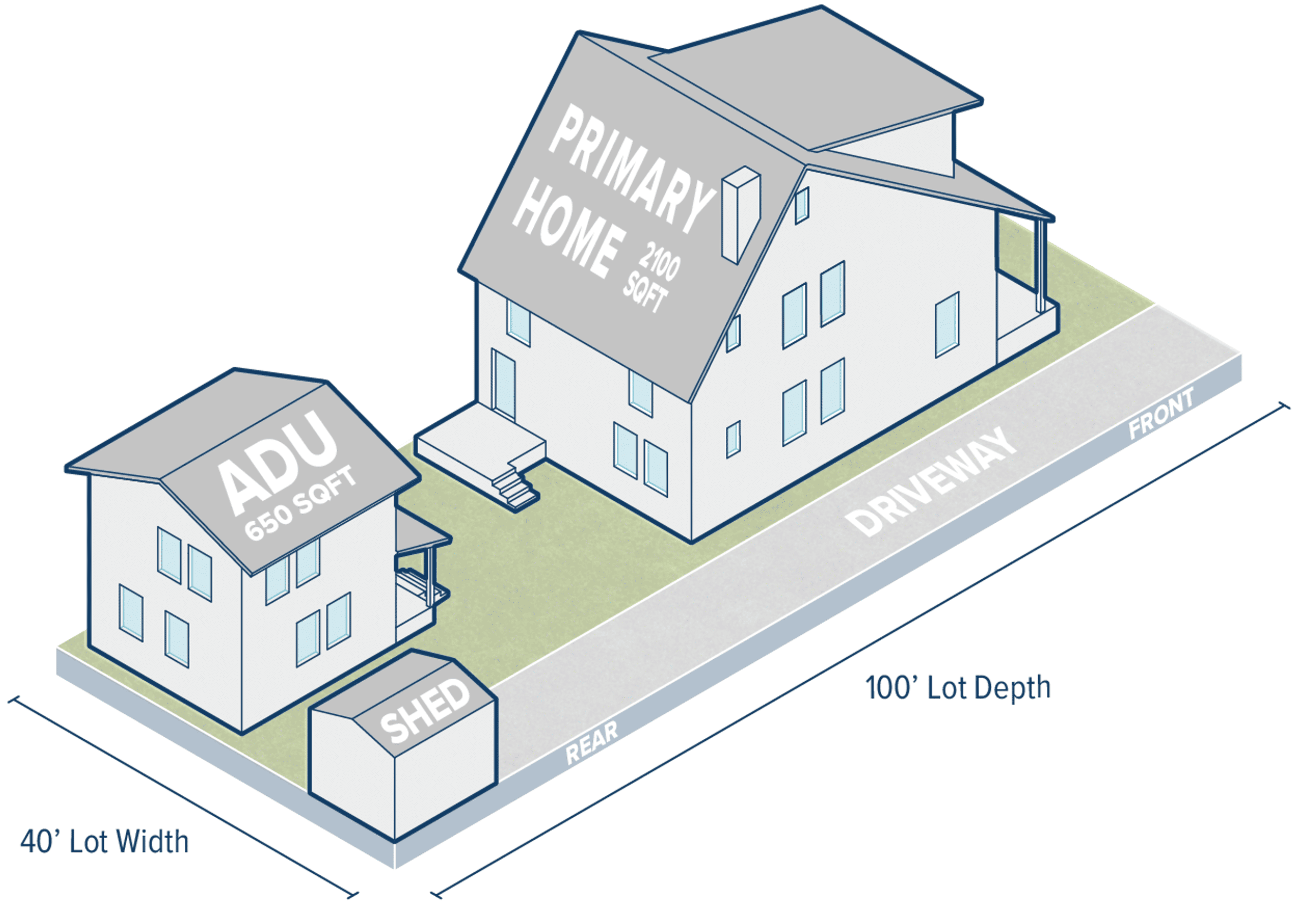
Example of an Accessory Dwelling Unit (ADU) on a large single-family parcel
The City of Yes and What It Allows
Under the new regulations, New York City will explicitly permit ADUs on the same lot as a single- or two-family home. The new rules define an ADU as a secondary dwelling unit with its own living facilities, including a kitchen and bathroom. Key provisions include:
One ADU per lot: A single- or two-family home is permitted to have one ADU.
Size limits: The ADU cannot exceed 800 square feet and cannot cover more than 33% of the required rear yard area for a detached structure. There is no minimum size, but the unit must comply with the Housing Maintenance Code’s room size requirements.
Building Types: ADUs are only allowed on lots with one and two-family buildings, excluding row houses, townhomes, and attached buildings (generally properties corresponding to building classes A4, A5, B1, and B9).
Dimensional Criteria and Access: ADUs must be within 100 feet of the street curb with a 5-foot-wide access path and located at least 5 feet from lot lines. The distance between buildings shall be no more than 10 feet between detached ADU and other buildings.
Location: ADUs are not allowed in historic districts nor in low-density contextual residential zoning areas (R1A, R2A, and R3A unless they are in the Greater Transit Zone).
Flood Risk: Any ADUs in a coastal flood zone must be elevated above a floodplain. Basement and cellar ADUs are not allowed in high flood risk areas.
Owner Tenure Occupancy: The property owner must live in either the primary dwelling or the ADU.
Parking: The new rules eliminate the requirement to add a new parking spot for an ADU.
Zoning and Regulatory Hurdles: The Restrictive Side
While the new zoning rules are a positive step, many of these specific provisions will maintain significant barriers that will severely limit the number of properties where an ADU can be built.
An RPA analysis of the existing housing stock and applicable regulations reveals that a substantial portion of the city’s single- and two-family homes will remain ineligible for building or legalizing ADUs. Of the 565,400 total single- and two-family lots in the city, an estimated 460,000 will remain barred from adding an ADU, leaving only about 68,000 lots where this housing type could be allowed. Only 12% of the city’s one and two-family building properties will be allowed to have an ADU. Based on owner preferences and financial feasibility, an even smaller fraction will materialize into safe and licensed ancillary units.
In a scenario where one out of every five eligible properties builds an ADU — a high-end estimate — these units would only account for approximately 3.5% of the new housing stock projected for the city by 2040. In comparison, the Bay Area and Los Angeles permitted approximately 11,600 and 26,400 ADUs between 2018 and 2021, respectively. ADUs represented 13% and 32% of the new housing stock created in these two California regions, which is four to nine times greater than what is likely to occur in New York City.
The restrictions are not evenly distributed across building types:
Detached Buildings: The regulations are more permissive for detached buildings, with 29% of these lots (54,000 out of 185,400) being potential candidates for ADUs.
Semi-detached Buildings: Only 9% of semi-detached buildings (14,500 out of 160,000) are potentially eligible.
Attached Buildings: The rules are most restrictive for attached buildings, with 0% of these lots (0 out of 219,900) being eligible.
Percent of 1 & 2 Family lots eligible for an ADU by Community District
A closer examination of the specific barriers reveals that individual provisions contribute significantly more than others in the high rate of ineligibility. The most significant obstacles are those related to building type, dimensional criteria, and housing tenure. Approximately 53% of single- and two-family lots are deemed ineligible based on their building type, dimensional criteria such as lot size or setbacks, block 51%, and tenure restrictions, 45%. Approximately 18% of the lots will be restricted due to contextual zoning and historic district requirements.
While necessary safety regulations related to fire, egress, and flood risk also apply, the primary challenge to expanding ADU access are the provisions related to building typology, dimensional criteria, and tenure. Such factors will severely limit the scale to which ancillary units could become part of the city’s housing stock.
The Road Ahead
The intent behind the new ADU regulations is clear: to increase the rental housing supply in a way that is safe and responsible, while offering flexibility and support for homeowners. However, the practical application of these rules may mean that the number of new, legal ADUs created falls short of the city’s ambitious goals. The stringent zoning provisions related to building types, dimensional criteria, and housing tenure, which exclude a vast number of properties, are the main factors limiting the impact of the reforms. For ADUs to truly have a transformative impact on the housing crisis, the city may need to re-evaluate recently adopted zoning rules that will prevent most single- and two-family homeowners from creating this crucial housing stock.

