

From power generation and the history of the grid to what’s driving up your electric rates, RPA’s E&E team has been busy getting into all the details.
What’s happening with electricity rates in New Jersey?
On June 1, 2025, electricity rates in New Jersey increased significantly. The average residential customer in New Jersey saw their monthly electricity bill increase between about 17 to 20%, depending on which utility company serves them. New Jersey already has some of the highest electricity prices in the country, and this rate hike further burdens New Jersey ratepayers. This post aims to understand what has driven the recent rate hikes by looking into the factors involved in setting rate prices, who is responsible for setting them, and what steps could be taken to avoid future rate spikes.
Key Takeaways
New Jersey’s rate hikes boil down to three main factors: energy supply, demand for energy, and global increases in energy costs. We summarize and describe each in greater detail below.
Energy Supply
In the PJM service territory, supply has been decreasing. Generator deactivations from both planned retirements and stronger reliability requirements have reduced the amount of supply on the system. At the same time, the interconnection queue, or the process for new energy to enter the system, has been stalled for the last five years, preventing new, predominantly solar and wind, generation from entering the grid. PJM’s interconnection queue issues led to litigation with FERC, which pushed this year’s capacity auction to take place just a year before the cycle, instead of the standard three years. Accurate forecasting has also affected supply - PJM bases its forecasts on state generation targets but does not forecast for potential missed targets.
Demand for energy
Demand for energy is also rising throughout PJM. Overall load growth has climbed from around 1% per year up to 3% per year, expected to grow to 5% per year over the next decade. Peak demand is projected to reach 154 GW this year - their highest projected demand. Data centers are a major contributor to that demand, accounting for 4% of PJM’s load today. Data center demand projections are estimated to take 12% of the load by 2030. Increased demand from data centers is attributed to about two-thirds of the increased prices in the PJM system this year.
Global increases in energy costs
Over the last five years, energy prices have fluctuated significantly. Supply chain issues caused by the COVID-19 pandemic still persist, and the oil and gas markets are still reeling from Russia’s invasion of Ukraine, although they have started to stabilize.
How are the rates set?
Rates in New Jersey are set through a two-step process. The first process is through PJM, the regional transmission organization, or grid operator, that oversees the grid in New Jersey as well as all or parts of twelve other states.
PJM Reliability Pricing Model (RPM)
PJM runs a capacity market, called the Reliability Pricing Model (RPM), which is intended to secure commitments for enough power to maintain grid reliability at forecasted peak demand (the period where power demand is highest) and system emergencies, three years ahead of when it would actually be needed. Those commitments are made through an auction where PJM accepts offers from energy generation operators, starting with the lowest cost and progressing steadily higher until enough capacity is secured, at which point the auction closes, and all who had committed to provide power are paid that final clearing - or “marginal” - price.
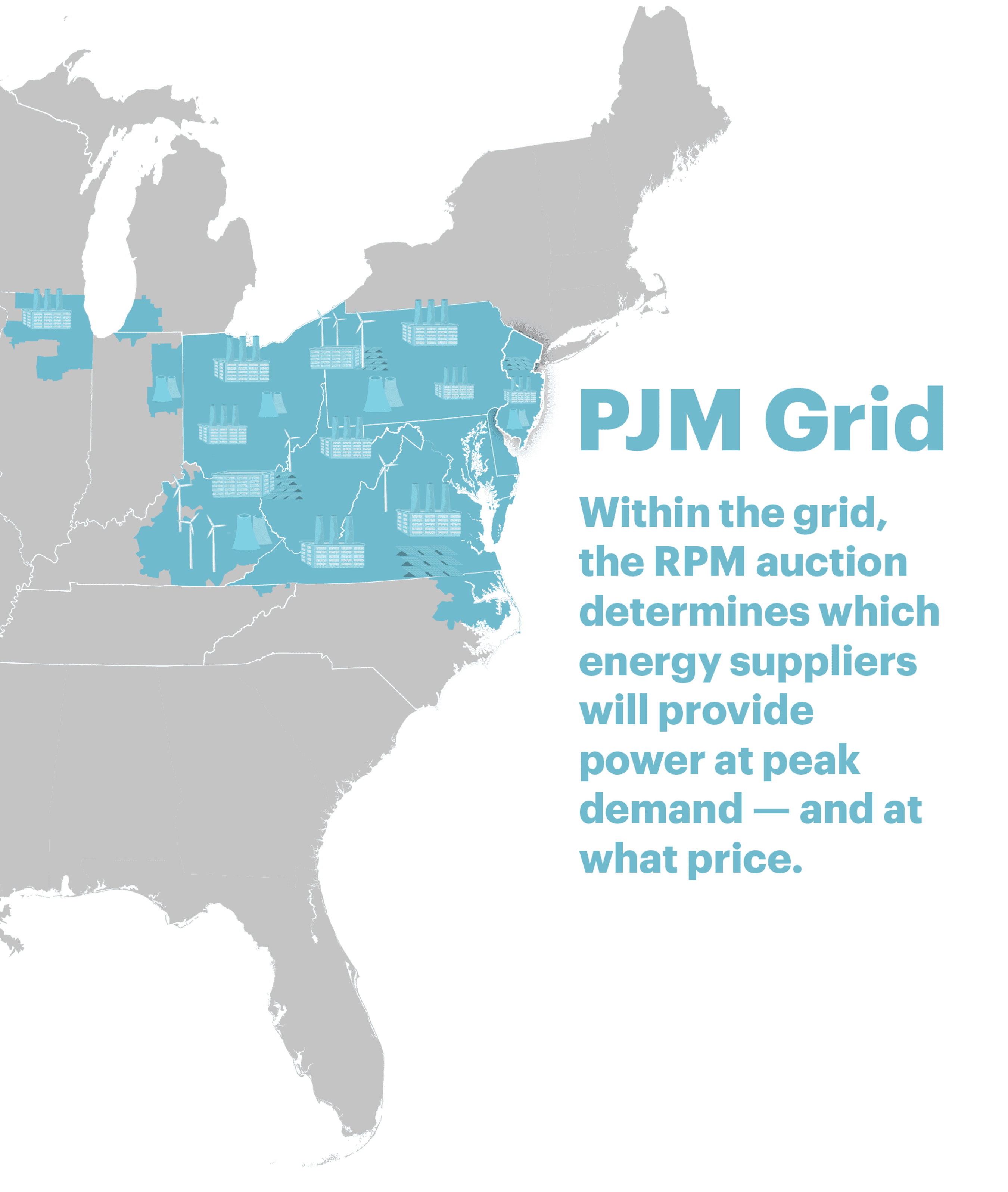
Types of capacity factored in includes new and upgraded generators, existing generators, and energy efficiency and transmission upgrades. Limitations of the transmission system and demand factors are taken into account in the pricing models.
NJ Basic Generation Service (BGS) Auction
Following the PJM auction, the four New Jersey utility companies, or Electric Distribution Companies (EDCs) (PSEG, JCP&L, Atlantic City Electric, and Orange & Rockland), participate in an auction for Basic Generation Service (BGS). In the BGS auction, the utility companies bid to procure everyday electric supply through the PJM market for their customers who do not purchase power from a third-party supplier. This determines the cost of power for all ratepayers, not just during peak.

The auction - held annually on a rolling basis - procures one third of a given year’s power at an agreed-upon price, for the next three years. So for the forthcoming year, the final third of energy needed will be procured at a given price, with two-thirds having already been procured in the prior two years’ auctions. The second third of procured power will be determined for Year 2, while the first third of power needed will be procured for Year 3. In the auction itself, energy producers bid to serve the load of one or more of the EDCs for three years. There are multiple rounds of the auction, with each round closing at 100 MW of peak demand for residential customers, and 75 MW for commercial customers. The winners of the auction supply the EDCs with electricity and are required to fulfill the PJM capacity market guidelines - ensuring that there is enough power for peak demand and system emergencies. The rates customers pay come from the clearing prices of the auction itself, and can vary by time of year or time of day.
The road to rate hikes in New Jersey
So, what caused the higher auction prices that led to such increased rates for New Jersey residents and businesses? There is not one single factor but rather a series of interrelated and compounding issues that resulted in some of the highest price increases in decades. These factors are detailed below.
Rising cost of fuels globally
Global energy prices saw historic lows during the COVID-19 pandemic, only to skyrocket two years later. While prices of natural gas started to rise in 2021, they leaped when Russia invaded Ukraine in February 2022. As countries started to sanction Russia and Russian gas, global supply was significantly cut. European countries started to purchase more from the United States as well, which reduced the supply in the domestic market. While prices have since come down since the initial shock and shifting of global trade patterns for oil and gas, they are still higher than pre-pandemic levels and will likely remain higher.
In fact, as of quarter 1 of 2025, global liquid natural gas (LNG) supply only grew a small amount, reflecting the slow rebound of prices due to the war’s disruption. Natural gas supplies around 40% of PJM’s service territory, so overall energy prices are particularly affected by natural gas price fluctuations. Coal prices have also risen in recent years, after seeing a COVID era low. While there are no coal-fired power plants in New Jersey itself, coal currently supplies around 12% of PJM’s service territory, and accounted for 18% of the energy supplies cleared in the capacity auction.
Supply and Demand Control the Markets
Much of the reason for the rate hikes comes down to basic supply and demand. Demand for energy is on the rise - for various reasons - while supply is becoming more limited for numerous others, leading to a spike in prices.

Data center growth increases demand
Growth of data centers has led to a significant increase in energy demand. But to keep prices low, demand must be exceeded by supply. Meanwhile, in PJM’s territory, demand is getting closer and closer to surpassing supply as aging and inefficient power plants (primarily coal and natural gas) are being slowly retired, with more to come. Total retirements through 2030 reflect 21% of PJM’s capacity as of 2022. But the pace of new generation interconnections has not exceeded the pace of these retirements or load growth, as energy-hungry data centers boom.
Interconnection queue issues that limit energy supply
The interconnection queue is the name for the list of proposed energy projects awaiting approval by a grid operator to be connected to the grid. While on the queue, projects undergo studies and assessments that determine how the projects will affect safety and reliability.
Once reviewed, projects are either rejected and must reapply, or are approved and can proceed. For the last several years, the PJM queue has been in chaos. Projects have been stuck in review for years, forced to either withdraw or delay construction. Projects stuck in the queue have been overwhelmingly clean power sources. As of April 2024, there was over 225 GW of capacity being reviewed, nearly 98% of which was solar, storage, or wind (land-based and offshore). Due to the long review process in the PJM queue, projects that could have been built over the last three or more years have not been built, as they have not yet been properly reviewed. This lack of development has reduced supply as old generators retire and demand from data centers and other large load centers increase. Had these renewable energy projects been approved and built, such as offshore wind, supply would not have been as constrained and prices would not have risen as high. Interconnection queue issues are not unique to PJM, but are prevalent throughout the entire country. In 2023, the Federal Energy Regulatory Commission (FERC) issued Order No. 2023, requiring all ISOs and RTOs to adopt new interconnection queue rules, including a requirement to study projects in clusters to improve queue timelines. PJM resisted this order, leading to administrative proceedings with FERC. These proceedings delayed the capacity market until a verdict was determined, which caused the capacity market auction to be pushed two years later than it was originally scheduled.
Interconnection issues are compounded by permitting delays. Once projects have an interconnection agreement, it may take at least two years for their project to come online, with siting and permitting being one of the largest points of uncertainty for developers.
Capacity market delays that slow new energy supply
Another factor is the capacity market, and its delayed timeline. As mentioned previously, interconnection issues have tightened supply in the region, forcing prices up significantly. The delayed capacity market auction has worsened the effects of the interconnection queue. As described above, the grid operator’s RPM typically runs in a three year cycle, meaning capacity is purchased three years ahead of when it is needed. The three year cycle was first established when the average time to build a power plant - from queue to commissioning - took about three years. Due to the slow interconnection process, as well as lengthy siting and permitting issues, made worse by supply chain issues, this is no longer the case. As a result, auctions - like the most recent RPM - are taking place too close to the time where energy is needed. This means that generating units in the queue do not have adequate time to be built and make up the extra needed capacity by the time the RPM takes effect. The final issue within the capacity market itself was the addition of a new reliability rule. In early 2024, FERC approved a new capacity accreditation for PJM. This rule is designed to better understand the reliability of any resources within the PJM system during extreme weather or peak load conditions, and was designed to ensure the grid is resilient in times of strain and reduce the expected loss of load during those events. While this is an inherently good rule that will increase system reliability in the long term, the immediate implementation of this rule during a time when new capacity is having a difficult time entering the system significantly reduced the available supply during the most recent auction. The total excess capacity went from over 16,000 MW in the 2024/2025 year to just over 500 MW of excess capacity in the 2025/2026 year, a significant reduction in total available capacity.
Failure to meet forecasted supply goals with aging infrastructure
The final pieces of the puzzle have to do with increasing transmission charges and state electrification and renewable energy goals. Transmission charges have slowly been creeping up over the last few years, due to aging infrastructure and efforts to upgrade existing infrastructure as well as build out new wires and substations. Additionally, many states within the PJM footprint have set renewable energy and electrification goals. Electrification efforts, such as the electrification of the Port of Newark, increase the overall load of the system, which can increase prices if there is not enough supply in the system to match it (relating to interconnection issues). State renewable energy goals can also increase prices if the states do not meet those goals when they are supposed to - the grid operator does not account for missed targets in their scenario planning, leading to lower supply than forecasted if a state does not achieve its goals in the set timeframe. Transmission investment is also tied to renewable energy investment, such as the New Jersey State Agreement approach for offshore wind - building renewable energy leads to building out and replacing transmission infrastructure.
All of these factors are major contributors to the recent New Jersey rate hikes, although they are not unique to New Jersey. Every state within the PJM territory is experiencing these rate hikes this summer - for example, Pennsylvania is seeing increases between 10% and 20%, Ohio is seeing increases between 10% and 36%. Electricity rates and energy markets are complex structures that fluctuate based on several different factors.
What can change going forward?
While there are many different opinions, in reality, there is no one correct answer. There are a variety of steps that could be taken to avoid higher rates.
Build offshore wind and other renewables and upgrade transmission
The best way to reduce costs when demand is rising is by increasing supply. Building out the energy projects that have been proposed, and in some cases permitted, to add to supply, as well as the transmission infrastructure necessary to upgrade the grid can help to meet growing demand. In New Jersey, that includes solar, and most significantly, offshore wind, as the state is constrained by geography and density for large, on-shore renewables and other power generation. Offshore wind is the fastest and most reliable way to provide the gigawatts of capacity needed to meet demand. And transmission projects to better connect the grid and make it offshore wind-ready are crucial.
Improve scenario planning, siting and permitting practices
PJM can also factor in state’s missing energy and electrification goals into their scenario planning, allowing developers to build more generation to meet the possible gaps. Siting and permitting reform needs to happen as well to make it easier to build clean energy faster.
Take executive action
The high prices have spurred action from PJM, brought on by pressure from internal and external forces. In December 2024, Governor Shapiro of Pennsylvania filed a lawsuit against PJM with FERC which successfully lowered the cap for the next capacity auction by 35%, dropping from the $500/MW-day cap sought by PJM to about $325/MW-day. Without the lowered cap prices would likely have increased by several billion dollars yet again. In the 2026/2027 auction, which took place in July 2025, the price cap was hit, with a final price of $329.17/MW-day, indicating another rate hike which will go into effect June 2026. While supply did increase marginally, many of the same issues have persisted, and the price would likely have exceeded the cap had it not been put in place.
On July 16, a bipartisan coalition of nine governors from New Jersey, Delaware, Illinois, Kentucky, Maryland, Michigan, Pennsylvania, Tennessee, and Virginia signed a letter calling on the PJM Board of Managers to significantly improve transparency and restore confidence for the millions of ratepayers it serves, as well as proposing the states collectively nominate candidates for the two open Board seats, instead of solely the Nominating Committee.
Reacting to internal pressure, PJM has taken a number of actions to improve their own processes. These include interconnection process reform, including a reliability resource initiative to fast track shovel ready projects; a surplus interconnection service tariff filed with FERC to allow new generating units to use unused interconnection infrastructure; and capacity market adjustments which intend to better reflect current economic conditions and status of generating resources.
As energy demands continue to increase, while pathways to increased supply are being cut short, New Jersey faces a challenging future. While some steps have been taken to head off future rate hike shocks, much more needs to be done to secure a stable and affordable energy future.


Related Lab Posts
Jul 2026
in New Jersey