Last week, NYISO released their annual Power Trends report. Power Trends explores the state of New York’s grid and electricity market, looking at reliability, demand, and the energy transition. This is a particularly timely report, with the recent changes to the CLCPA and SEQRA as well as federal policy changes surrounding clean energy over the last year and a half.
NYISO is quite comprehensive and forward looking with their reports. They are, however, conservative in their forecasts. And they need to be - their charge is to ensure that New York State has constant, reliable electricity. They plan for the worst case scenario so that it does not happen.
That being said, there were some noteworthy takeaways from the most recent Power Trends report:

The most important takeaway from the Power Trends report is that statewide reliability margins are tightening. Summer capacity margins have dropped from 2,227 MW in 2019 (or 17%) to only 417 MW in 2026 (or 9%). Since 2019, only 2.9 GW of capacity have been added to the grid while 4.4 GW has been retired.
There are several factors that have contributed to this decline. The first is the age of the fossil generation fleet. Fossil generation, NYISO argues, has helped maintain reliability, but is aging and no longer fully reliable. Over 12,500 GWh of generation in New York state comes from fossil fuel power plants that are over 50 years old (or 10% of in state production). Aging units, in addition to state policy around decarbonization, has led to a number of fossil fuel plant retirements.
Winter conditions have emerged as a more recent reliability stress. Storms like Winter Storm Fern in January 2026 showed the volatility of fossil fuel prices and the vulnerability of fossil supply even within the U.S. (compounded by disruptions and price volatility from the Iran war). With a continued shift to greater electrification of heating, winter demand will be higher, leaving a larger portion of our economy dependent on the electric system, which remains vulnerable to fuel price shocks to the extent it continues to rely on fossil fuels, all of which are imported and therefore all of which are subject to global and national market disruptions.
There has also been a rise in demand from data centers and other large loads like semiconductor fabrication, but it is unclear yet to what extent demand will rise. In 2022, there were six large load projects in NYISO’s interconnection queue that added up to 1,045 MW of demand, but by May 2026, there were 51 projects that added up to 12,670 MW of demand. Much of that future demand is uncertain, since not all projects will come to fruition. For the purposes of planning, NYISO predicts that 2,880 MW of the demand will be integrated into the grid by 2040.
The difficult combination of unpredictable rising demand and federal policy coupled with generator retirements creates a need for more comprehensive scenario planning, NYISO argues.
Solar, particularly behind-the-meter (BTM) solar, has been critical in reducing daytime demand. BTM solar on homes and businesses reduce strain on the grid, operating at peak efficiency at the hottest hours on the hottest days, but it does not operate during the night. In the June 2025 heatwave, evening temperatures stayed high and the system operator could not rely on solar to smooth demand in the evening hours. There were also operational challenges during Winter Storm Fern in January 2026. At peak snowfall, solar panels were covered with snow, meaning they could not generate electricity.
Onshore wind has also increased reliability, particularly in the winter when the wind blows stronger and there is greater price and supply volatility for natural gas. During Winter Storm Fern, onshore wind was generally strong, although it was highly variable, requiring operator intervention.
Overall, NYISO argues that we need more solar and wind power on the system, but that it also needs to be paired with long duration energy storage to ensure peak operational efficiency. While wind and solar on their own are extremely useful to the system, they are most useful when paired with enough storage to smooth demand curves. NYISO ascertains that renewables, particularly when paired with energy storage, can not only stabilize prices, but lower them in the long term as they do not require fuel inputs - the wind and sun are free resources.
With the CHPE line going into operation earlier this month, the predicted reliability concerns for this summer diminish, but don’t fully go away. The CHPE line will bring up to 1,250 MW of Canadian-generated electricity directly into New York City. This will reduce the reliability gap significantly, but not enough to remove the reliability warning for this summer. CHPE is also not contractually obligated to serve in the winter. This summer is expected to be particularly hot due to the recently formed El Niño event.
Long Island is expected to experience a similar reliability concern starting summer 2027, as it is geographically constrained from the rest of the system, and faces significant congestion in bringing power from upstate. This raises costs for the whole system, and potentially threatens Long Island’s reliability as generators are scheduled to retire, with some retiring as soon as 2030 per the DEC peaker rule. The Propel NY Energy project is critical to removing this reliability concern - the project, expected to be energized in 2030, will bring up to 3,000 MW of power directly from upstate to Long Island, and has the potential to send power from Long Island back upstate as well.
NYISO argues that New York needs more firm, emissions free generation for the long-term, and suggests repowering decommissioned natural gas power plants in the short term. They do not, however, go into the economics of repowering decommissioned plants or the supply chain challenges facing natural gas. Repowered plants would need new combined cycle turbines. Those turbines have at least a five year wait time and costs have increased nearly 200% since 2019. Wind and solar can be deployed in a similar amount of time (or less) for less money - in an era of rising electricity bills, we should move forward with the least-cost options.
NYISO’s interconnection queue reform, which shifted the review from a first-come first-served process to a cluster study, has improved timelines for recent projects. But there are, NYISO argues, other factors outside of NYISO’s control that slow down energy development. These include supply chain challenges, state and federal permitting, and changes in tax incentives. NYISO argues that, since they have approved more than 100 projects since 2019 but only 14 are actively under construction, that the bulk of the issues lie outside of their control, although hundreds of projects have withdrawn themselves from the queue during that time period. Interconnection queues nationwide for both supply and demand are notorious for being filled with projects that will never materialize - developers hedge their bets queueing the same project in multiple locations, creating “ghost load”.
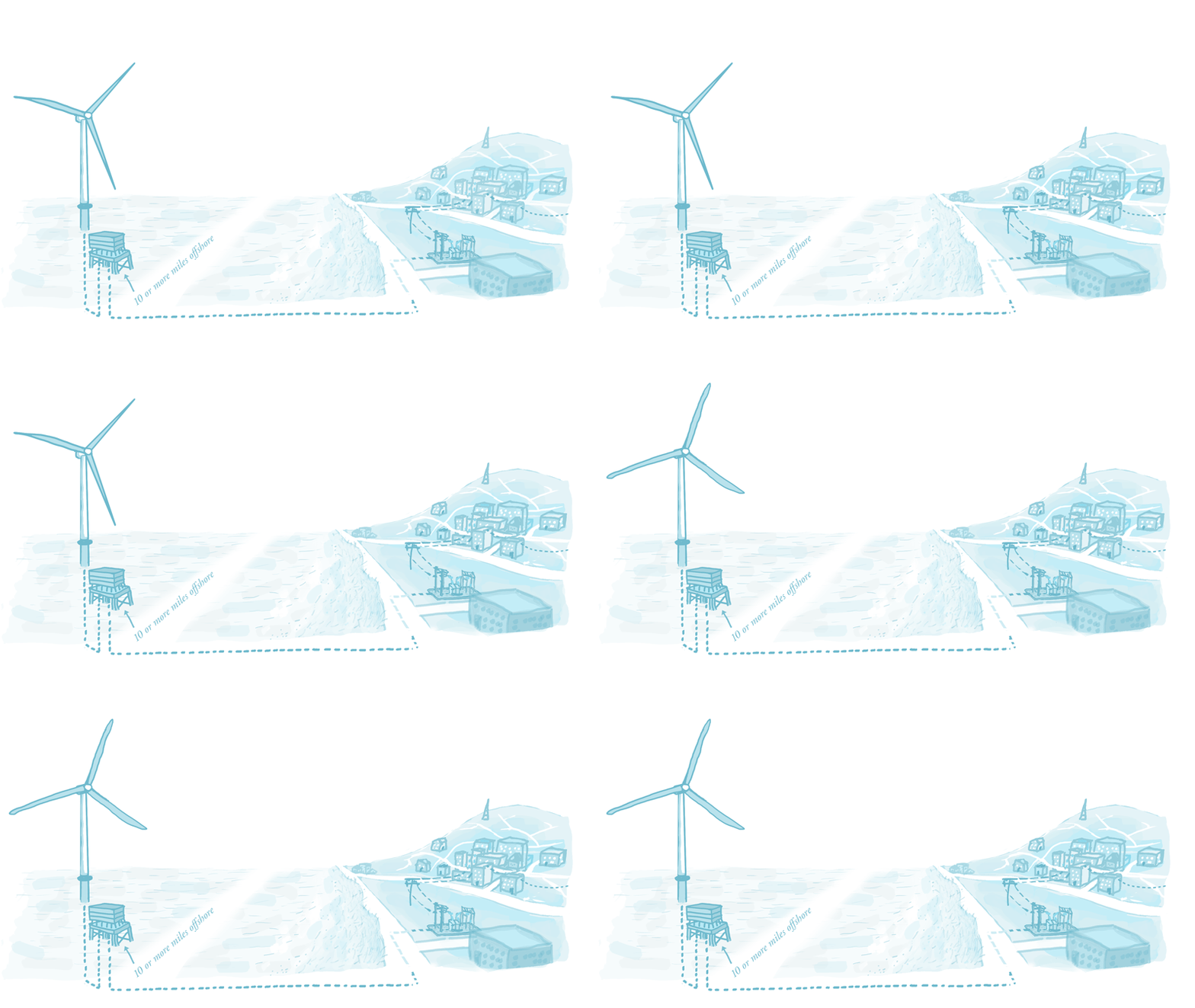
Offshore wind, one of the state’s most abundant resources, was mentioned only in terms of the current energy mix. The two offshore wind projects that are set to deliver electricity by 2027, Empire Wind and Sunrise Wind, have a combined capacity of about 1.7 GW. Once these projects are complete and integrated into the system, they will help increase the supply margins, and help stabilize prices for the state. New York has an additional four projects with Construction and Operation Plans (COPs) approved by the Federal Bureau of Ocean Energy Management. These four projects - should they be constructed - have a combined capacity of nearly 5.7 GW, which, if added to the two already under construction, would have more than enough capacity to meet the grid’s demand for the next decade or more.
The combined capacity of offshore wind projects planned or under construction (with even more capacity in lease areas that haven’t yet been approved), and the existing fleet of carbon-free generation offer far greater capacity than NYISO’s recommended repowering of decommissioned gas power plants, which would only provide an additional 3.5 GW of power. Additionally, leveraging the 3 GW of transmission capacity that the Propel project will bring, plus any revised approach or revival of the Clean Path transmission project could further leverage the abundant fossil-free resource just off New York’s coast and provide reliable, affordable, clean energy for all New Yorkers.
